Citizen’s trust and societal polarization in times of transformation

Djamila Jabra, Katja Stempel, Alexander Hartland, Martin Ulrich, Phillip König, Rosa Maria Navarrete and Giuseppe Carteny
The 2025 conference of the research section “Comparative Politics” of the German Political Science Association (DVPW) was dedicated to the topic: “Citizen’s Trust and Societal Polarization in Times of Transformation: Comparative Perspectives from Different World Regions.” Around 100 scholars from across Europe gathered from March 27 to 28 at Saarland University in Saarbrücken for the largest political science event to date hosted by the two political science chairs of the university’s still young department for European Social Research.

https://doi.org/10.1007/s12286-025-00643-0

Party competition on European issues in the 2024 EP elections

Giuseppe  Carteny,  Daniela  Braun,  Alexander  Hartland and  Ann-Kathrin Reinl
Recent developments have turned European integration from a “sleeping giant” into an active political issue. The Maastricht Treaty politicized Europe in national and European Parliament elections. Cross-border crises, like migration and environmental challenges, have further increased the importance of coordinated EU responses. Moreover, an entirely new family of Eurosceptic parties has emerged and consolidated over the past decade. Given that one of their main aims is to challenge and criticise the European Union (EU), Eurosceptic parties have a particular interest in European issues – the European polity as well as major European policies. Against this background, this paper examines whether and how political parties have emphasised these issues during the 2024 EP elections, compared to 2019, and contrasting Eurosceptic and mainstream parties. Drawing on annotated data from the 2019 Euromanifesto project, we fine-tune transformer-based deep learning multilingual models to detect parties’ salience and positions on European polity and policy issues in nine countries during the 2024 EP elections. Our analyses show that the salience of European issues has increased on average, in particular for the EU polity. In terms of positions, we detect a pattern of increasing negativity of mainstream parties on European policy issues, such as migration and the environment, whereas Eurosceptic parties (in particular of the far-right) appear to have become less negative on the EU. In sum, our results suggest an increasing relevance of EU-wide issues, with different patterns of polarisation.

https://doi.org/10.36253/qoe-17373

What do we mean by “community”? Defining community for civically engaged research

Shelly Arsneault, Nhat-Dang Do, Curtis Kline, Matilde Ceron and Ashley Nickels
Community is an integral concept for civically engaged research (CER); however, it is also fairly nebulous. As political scientists explore issues relevant to conducting civically engaged research, this article addresses the question, “What is community”? Relying on various social science literatures, including the growing body of scholarship on CER in political science, we clarify key themes to help refine the definition of community for scholars, and introduce a Community Identification Matrix to help researchers reflect on the implications of working with their community partners. We hope that articulating the range of communities that may be engaged will help qualitative researchers as they conceptualize their civically engaged research, and that a more precise articulation of community will aid in the operationalization of variables, making CER a more viable research approach for quantitative researchers.

https://doi.org/10.1080/21565503.2025.2457994

Much Ado About Nothing? Assessing the Impact of the Spitzenkandidaten Process on EU Policy-Making (In: The Politicisation of the European Commission’s Presidency)

Edoardo Bressanelli, Matilde Ceron and Thomas Christiansen
The introduction of the Spitzenkandidaten process has sparked a rich debate on the implications for the ‘input side’ of EU democracy. In contrast, a limited attention has been devoted to the corresponding ‘output side’. Have European Commission Presidents wielded their power differently depending on whether they assumed office as lead candidates of a transnational European party or not? This chapter seeks to address this gap by examining the track record of Commission Presidents after their elections. The assessment is performed along three dimensions of EU politics: executive-legislative relations, party politics and the institutional balance in the EU. Specifically, three presidential terms are being compared to isolate the effects of the Spitzenkandidaten process: the second term of José Manuel Barroso, the single term of Jean-Claude Juncker and the first term of Ursula von der Leyen. Empirically, the chapter triangulates different methods of data collection and analysis, both qualitative—such as documentary research, process-tracing and interviews—and quantitative—such as voting behaviour in the EP and the textual analysis of official documents. Based on the available evidence, the chapter concludes that a Spitzenkandidat at the helm of the Commission has changed some limited aspects of the decision-making process, creating greater opportunities to cooperation among the supranational institutions, but has not transformed the consensual style of EU decision-making.

https://doi.org/10.1007/978-3-031-48173-4_13

Gendered Shades of Right? Gender+ Equality Issues in the Economic Right EP2024 Political Agenda (In: The 2024 European Parliament Elections)

Vera Beloshitzkaya, Matilde Ceron and Zoe Lefkofridi
Are gender+ issues salient in the economic right Euromanifestos in the 2024 elections? Is there an opposition to gender+ issues? How do parties frame these issues? We systematically code the manifestos of ALDE, ECR, and the EPP from the 2024 elections, mapping issue saliency and frames parties use when they talk about gender+ and anti-gender issues. Findings show different shades of right on gender+ equality and limited anti-gender stances, with support to LGBTQI issues and controversial topics such as the Istanbul Convention extending to the EPP. The study contributes to our knowledge of the saliency, framing, and ownership of gender+ issues in party manifestos at the European level, which remain understudied in the literature.

https://doi.org/10.1007/978-3-031-89455-8_20

The Changing Information Landscape and the Rise of Digital Technology: Friend or Foe of Representative Democracy? (In: French Democracy in Distress)

Felix-Christopher von Nostitz, Giulia Sandri and Marie Neihouser
This chapter analyzes the digitalization of the public sphere in terms of a shift toward digital media consumption and supply. It argues it presents significant challenges for democracy, as it potentially exacerbates inequalities in participation and representation due to varying levels of digital skills among citizens. These differences could hinder equitable access to information and effective civic engagement, raising critical concerns about inclusivity and the resilience of democratic processes. The chapter addresses this issue by exploring the effect of media digitalization on different types of political actor ranging from ordinary citizens to politicians and political parties. The chapter shows that trust in news media remains low and that, while social media lowers the barriers to participation and access to news, it seems not to empower new groups to become politically active. Most importantly, we find significant ideological polarization, not only across social media platforms but also between TV and digital media use. Thus, while the evolving information landscape and the rise of digital technology have transformed how citizens gather political information, participate in the political process, and how politicians and parties engage with them, the question of whether digital media is a friend or foe of representative democracy remains unresolved.

https://doi.org/10.1007/978-3-031-92213-8_7

France as a Lens for Understanding Democratic Challenges (In: French Democracy in Distress)

Nonna Mayer, Frédéric Gonthier, Élodie Druez, Felix-Christopher von Nostitz and Camille Kelbel
A wave of authoritarian and xenophobic populism is shaking liberal democracies, raising concern about their very capacity to survive. Using France as a magnifying lens, this book takes a less pessimistic perspective. Scrutinizing French society from political elites at the top to ordinary citizens at the bottom, it discovers considerable inequalities, tensions, frustrations, and distress, exacerbated by the dissolution of the National Assembly decided by President Macron in June 2024 and the political crisis it opened. Yet, it also provides ample evidence of citizen’s commitment to core democratic values, which, for the moment, resists. The historical progression of the far right in the elections of 2022–2024, unending waves of protest, and record levels of distrust in political institutions and parties express as much discontent as a strong desire for democratic rejuvenation. The French public massively calls for a more effective democracy, evaluating the performance of its governments against democracy’s own exacting standards. The principal cause of this crisis of representation, we here argue, is a growing disconnect between citizens’ demands and the response of political elites, aggravated by their tendencies to take advantage of democracy’s inherent weaknesses and by a rigid institutional framework. We believe, however, with tempered optimism, that these problems can be addressed, if democracy is made more participative, more redistributive, more inclusive, and more open to deliberative and direct democratic mechanisms.

https://doi.org/10.1007/978-3-031-92213-8_1

Benchmarking French Democracy (In: French Democracy in Distress)

Max-Valentin Robert and Felix-Christopher von Nostitz
France is generally considered to be one of the oldest liberal democracies in Europe. However, a decrease in trust in political institutions is highlighted in the studies on French political opinion. What we suggest here is to provide an overview of the current state of French democracy, through a cross-time and comparative perspective. Thanks to the mobilization of the synthetical index of democratization provided by V-Dem (the electoral democracy index), we will interpret the ongoing evolution of France’s institutional-political situation: what are the trends and dynamics which characterized French democracy, in the short- and long-term perspectives? In addition, we will analyze the state of French democracy by mobilizing other V-Dem indexes focusing on specific dimensions and/or kinds of democracy (the liberal, participatory, deliberative and egalitarian component indexes). The French case will also be studied in comparison with six other European countries—Germany, Italy, Spain, Hungary and Poland.

https://doi.org/10.1007/978-3-031-92213-8_3

A Realistic Call for Democratic Reform in France (In: French Democracy in Distress)

Frédéric Gonthier, Nonna Mayer, Élodie Druez, Felix-Christopher von Nostitz and Camille Kelbel
While the French public exhibits a consistent support for democratic norms and, notably, innovative forms of participation that seek to deepen democratic engagement, the country faces a mounting democratic crisis resulting from the persistence of large economic and social inequalities that exacerbate inequalities in political participation. This chapter makes the argument that the so-called democratic fatigue is, at its core, a fatigue among political elites who not only resist democratic reforms that would strip them of some of their power but also pave the way for authoritarian alternatives by failing to meet citizens’ expectations and taking advantage of democracy’s inherent weaknesses. The chapter also provides strong evidence that the resilience of French democracy rests on the public’s deep-seated commitment to democratic ideals and processes. However, without significant institutional and policy reforms, there is a growing risk that this commitment will erode, further empowering populist radical right-wing forces that capitalize on the democratic deficit.

https://doi.org/10.1007/978-3-031-92213-8_17

Unequal Political Participation in Austria: Do Gender Roles Matter? (In: 20 Jahre Österreich im European Social Survey)

Nadine Zwiener-Collins and Zoe Lefkofridi
Gender equality is not just one of the goals of the United Nations 2030 Agenda but the basic requirement for the implementation of this agenda. Austria’s membership of the European Union (EU) also obliges it to ensure equality between women and men. De spite continuous advances in gender equality over the last decades, Austria, like other European societies, is still characterised by inequality between men and women. In the most recent iteration (2021) of the Gender Equality Index produced by the European Institute for Gender Equality (EIGE), Austria ranks 11th amongst the 27 EU countries in terms of overall gender equality, achieving a score of 68 out of 100.1 Inequalities between men and women are pronounced in multiple areas, including employment, knowledge, and time use – the biggest gap, however, is found in the domain of ‘power’. This is important, because political equality is a fundamental prerequisite for gender equality in all other spheres of life.

https://doi.org/10.7767/9783205217183.95

Elgar Encyclopedia of Gender and Politics

Edited by Zoe Lefkofridi

The Elgar Encyclopedia of Gender and Politics establishes gender as a fundamental analytical category for understanding power relations in political science. This introduction traces the field’s evolution from its marginalized origins in the 1970s to its current status as a transformative subfield, highlighting the persistent resistance gender analysis has faced within political science despite its core concern with power. The encyclopedia addresses contemporary challenges including anti-gender backlash, digitalization’s impact on gender-based violence, and the fragility of women’s rights gains globally. Organized into nine thematic categories covering 86 entries, it encompasses feminisms and foundational theories, intersectionality, policy analysis, leadership, political behavior, conflict, and media representation. The methodology emphasizes diversity and inclusivity, featuring international contributors from varied epistemological traditions. More than a reference work, this encyclopedia serves as both a comprehensive resource documenting current gender and politics scholarship and a call to action for integrating gender analysis into political science research, teaching, and policymaking to foster more equitable political landscapes.

https://doi.org/10.4337/9781035322619.00007

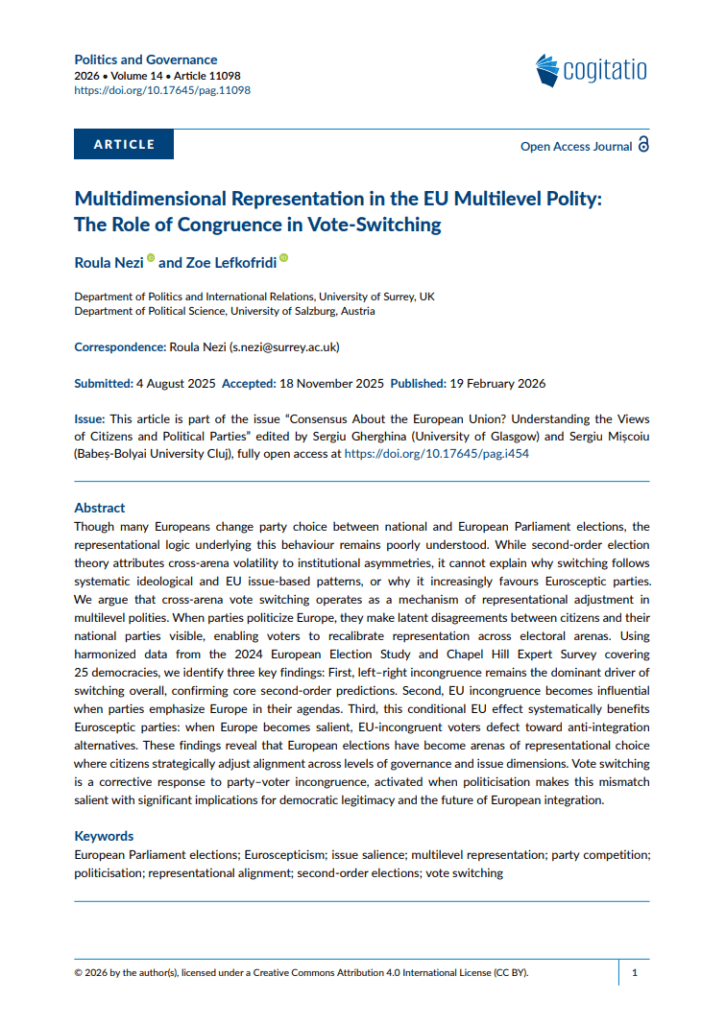
Multidimensional Representation in the EU Multilevel Polity: The Role of Congruence in Vote‐Switching

Roula Nezi and Zoe Lefkofridi

Though many Europeans change party choice between national and European Parliament elections, the representational logic underlying this behaviour remains poorly understood. While second-order election theory attributes cross-arena volatility to institutional asymmetries, it cannot explain why switching follows systematic ideological and EU issue-based patterns, or why it increasingly favours Eurosceptic parties. We argue that cross-arena vote switching operates as a mechanism of representational adjustment in multilevel polities. When parties politicize Europe, they make latent disagreements between citizens and their national parties visible, enabling voters to recalibrate representation across electoral arenas. Using harmonized data from the 2024 European Election Study and Chapel Hill Expert Survey covering 25 democracies, we identify three key findings: First, left–right incongruence remains the dominant driver of switching overall, confirming core second-order predictions. Second, EU incongruence becomes influential when parties emphasize Europe in their agendas. Third, this conditional EU effect systematically benefits Eurosceptic parties: when Europe becomes salient, EU-incongruent voters defect toward anti-integration alternatives. These findings reveal that European elections have become arenas of representational choice where citizens strategically adjust alignment across levels of governance and issue dimensions. Vote switching is a corrective response to party–voter incongruence, activated when politicisation makes this mismatch salient with significant implications for democratic legitimacy and the future of European integration.

https://doi.org/10.17645/pag.11098

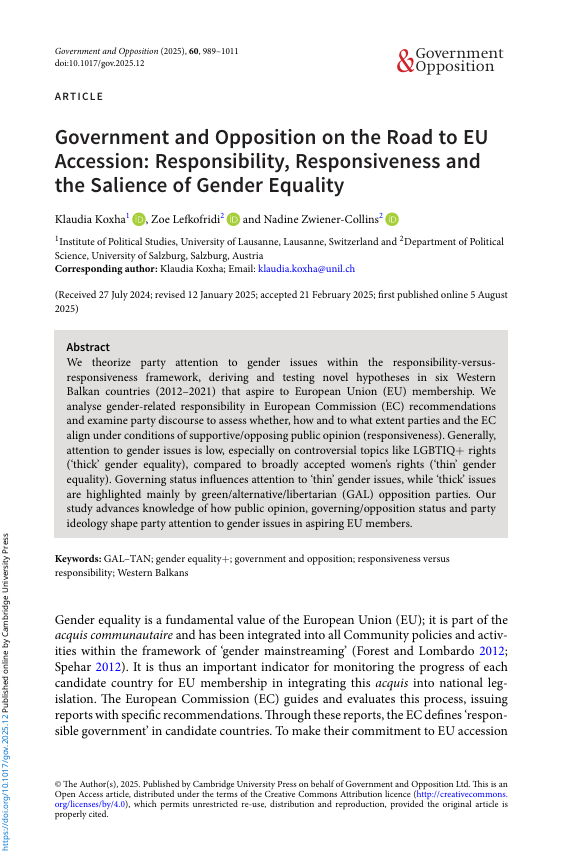
Government and Opposition on the Road to EU Accession: Responsibility, Responsiveness and the Salience of Gender Equality

Klaudia Koxha, Zoe Lefkofridi and Nadine Zwiener-Collins

We theorize party attention to gender issues within the responsibility-versus responsiveness framework, deriving and testing novel hypotheses in six Western Balkan countries (2012–2021) that aspire to European Union (EU) membership. We
analyse gender-related responsibility in European Commission (EC) recommendations and examine party discourse to assess whether, how and to what extent parties and the EC align under conditions of supportive/opposing public opinion (responsiveness). Generally, attention to gender issues is low, especially on controversial topics like LGBTIQ+ rights
(‘thick’ gender equality), compared to broadly accepted women’s rights (‘thin’ gender equality). Governing status influences attention to ‘thin’ gender issues, while ‘thick’ issues are highlighted mainly by green/alternative/libertarian (GAL) opposition parties. Our study advances knowledge of how public opinion, governing/opposition status and party ideology shape party attention to gender issues in aspiring EU members.
https://doi.org/10.1017/gov.2025.12.

Gendered dynamics in representation: Examining candidates' policy congruence with parties and voters

Zoe Lefkofridi, Carsten Wegscheider, and Nadine Zwiener-Collins

This study tests novel hypotheses on how gender affects candidates’ policy congruence with parties and voters. We argue that structural barriers lead female candidates to align more closely with their parties, while gendered ideological differences shape their congruence with voters across policy domains. Additionally, we examine whether candidates’ voter- or party-centric campaign focus mediates these gendered dynamics. Using data from the 2013 Austrian National Election Study (AUTNES) and blackbox scaling to estimate latent policy positions, we find no gender differences in candidate-party congruence. However, female candidates align more with female voters on the economic dimension but exhibit lower congruence with both female and male voters on socio-cultural issues. While voter-centric campaigns increase candidate-voter congruence on socio-cultural issues, campaign focus does not mediate gendered patterns of congruence. These findings shed new light on gender and policy congruence across dimensions, advancing our understanding of the dynamics between descriptive and substantive representation.

https://doi.org/10.1177/13540688251332188

Mind the Gender Gap: Political and Ideological Gender Differences in the 2024 European Parliament Elections (in Greek).

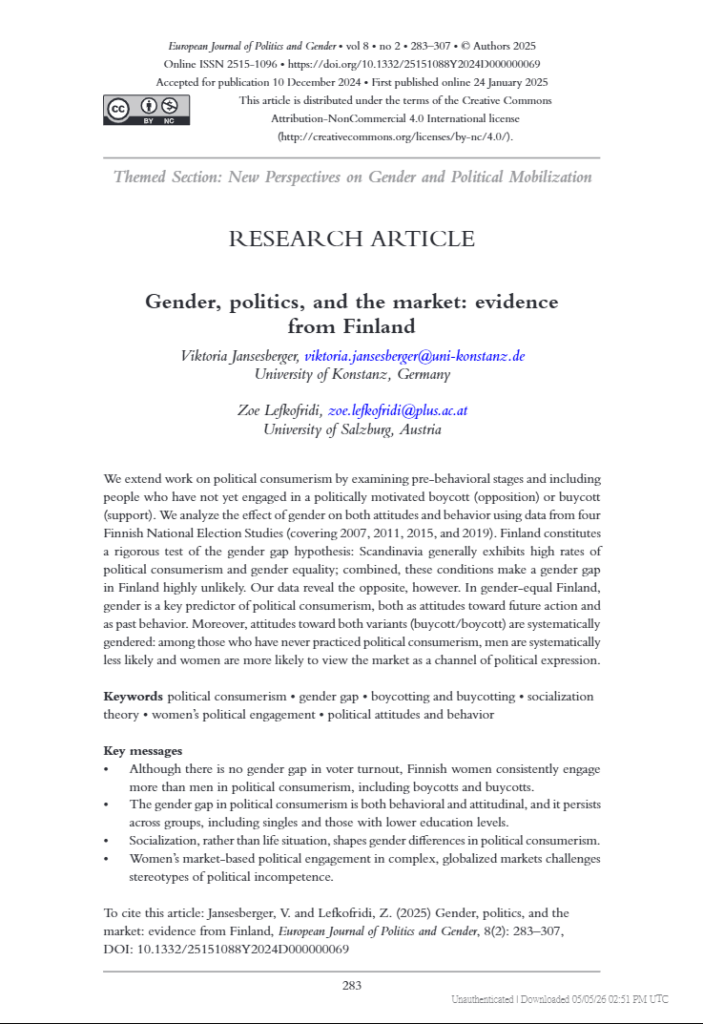
Gender, politics, and the market: evidence from Finland

Viktoria Jansesberger and Zoe Lefkofridi

We extend work on political consumerism by examining pre-behavioral stages and including people who have not yet engaged in a politically motivated boycott (opposition) or buycott (support). We analyze the effect of gender on both attitudes and behavior using data from four Finnish National Election Studies (covering 2007, 2011, 2015, and 2019). Finland constitutes
a rigorous test of the gender gap hypothesis: Scandinavia generally exhibits high rates of
political consumerism and gender equality; combined, these conditions make a gender gap in Finland highly unlikely. Our data reveal the opposite, however. In gender-equal Finland, gender is a key predictor of political consumerism, both as attitudes toward future action and as past behavior. Moreover, attitudes toward both variants (buycott/boycott) are systematically gendered: among those who have never practiced political consumerism, men are systematically less likely and women are more likely to view the market as a channel of political expression.
https://doi.org/10.1332/25151088Y2024D000000069

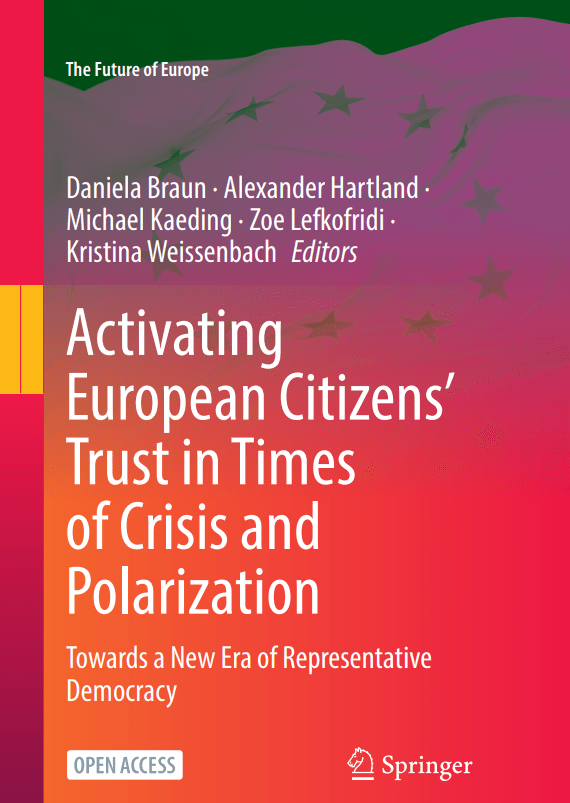
Activating European Citizens’ Trust in Times of Crisis and Polarization: Towards a New Era of Representative Democracy

Editors: Daniela Braun, Alexander Hartland, Michael Kaeding, Zoe Lefkofridi, Kristina Weissenbach

This open access book explains why representative democracies need political trust and legitimacy: Political trust is a crucial yet underestimated element in Europe’s representative democracies. A trusting relationship between citizens and the institutions of the state ensures the functioning of democratic systems, reduces transaction costs and facilitates the justification of political decisions. Without the commitment of a critical mass, democratic governments cannot gain legitimacy among the populace. While a stable relationship of trust between citizens and the state through political parties is a prerequisite for representative democracies in normal times, it is even more important in times of significant democratic change and turmoil, i.e., when democracies are in flux. Accordingly, the contributions gathered here examine political trust and legitimacy in Europe using a new conceptual framework – the ActEU conceptual triangle, which draws on citizens’ political attitudes, their political participation, and the representation of their political preferences to map and assess the decline of political trust and legitimacy in Europe.
https://link.springer.com/book/9783032191182

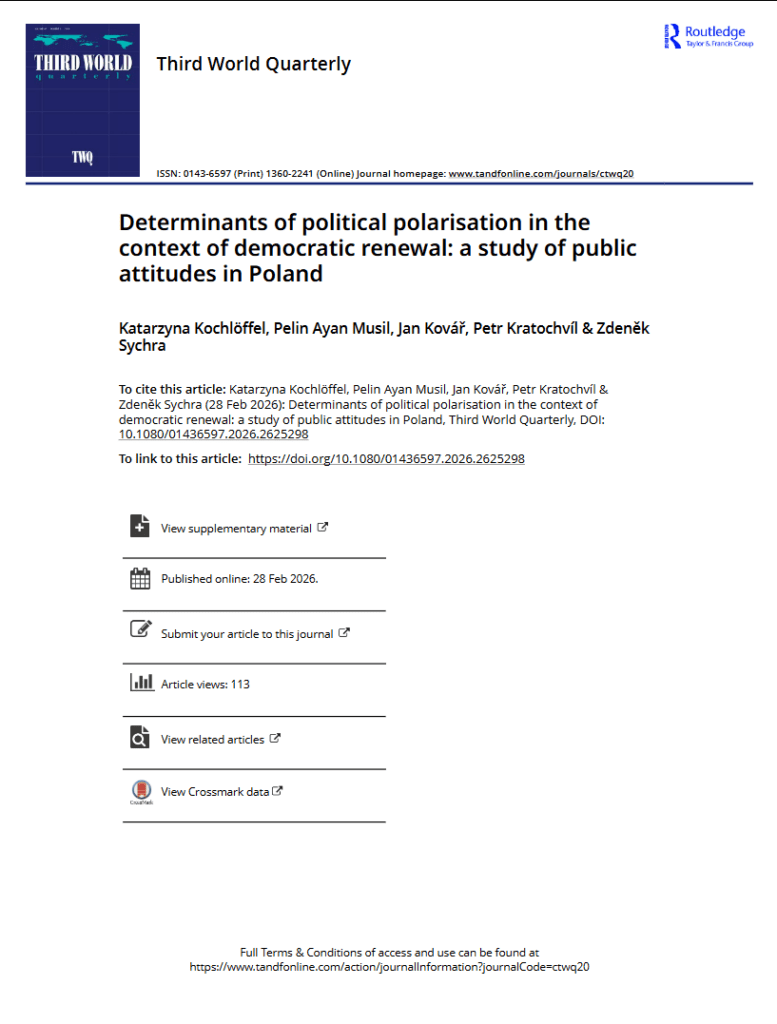
Determinants of political polarisation in the context of democratic renewal: a study of public attitudes in Poland

Katarzyna Kochlöffel, Pelin Ayan Musil, Jan Kovář, Petr Kratochvíl & Zdeněk Sychra

This article examines the dynamics of political polarisation in Poland in the context of democratic backsliding (2015–2023) and subsequent democratic renewal following the 2023 parliamentary elections. Drawing on newly released ActEU public opinion data, we demonstrate that the primary driver of polarisation during Poland’s democratic renewal was not the division between democratic and autocratic attitudes but rather a deep cultural conflict between liberal-progressive and traditional-nationalist values. Hence, the study shows that a democracy–autocracy divide does not need to manifest at the attitudinal level for democratic renewal to occur. Instead, the main pro-democratic party elites can strategically layer a democracy–autocracy narrative onto the dominant cultural cleavage to pull support from other parties before the elections and form a broader multi-party bloc that helps unseat the incumbents. These findings shed new light on the debate about the relationship between polarisation and democratic change, suggesting that pro-democratic actors can utilise polarising cultural conflicts to bring about democratic recovery.
https://doi.org/10.1080/01436597.2026.2625298

The role of key European issues in the 2024 election campaign

Alex Hartland, Daniela Braun, Giuseppe Carteny, Rosa M. Navarrete and Ann-Kathrin Reinl

International crises and Euroscepticism have made European issues prominent in citizens’ lives. This article studies the role of three key European issues – migration, the environment, and EU integration – for political parties and citizens. The analysis centres on nine EU member states, combining party manifestos from the 2024 European Parliament elections with survey data. It finds a gap between the concerns of citizens and the political parties, an important consideration for election campaigns in general. Moreover, the analysis suggests that the salience in party manifestos has a modest direct influence and a stronger indirect impact on their appeal to citizens in most countries studied. Specifically, citizens concerned with migration and the environment evaluate parties based on the prominence they give to these issues during the campaign. The findings offer important avenues for further research on party issue emphasis and the measurement of issue salience via large language models (LLMs).
https://doi.org/10.1080/01402382.2025.2498838

Politisches Vertrauen in Europa im Kontext von Mehrebenenstruktur und Polarisierung: Konzeptionelle Überlegungen

Daniela Braun and Michael Kaeding

European democracy is undergoing profound change. The various crises of the past 15 years and the transformations associated with modernisation, globalisation, geopolitics and Europeanisation are threatening the trust of citizens in political actors and institutions and the legitimacy of the EU multi-level system. This goes hand in hand with the polarisation of European societies. In order to counter these developments, the problems of trust and legitimacy must be better researched. This is where the ActEU research project “Towards a new era of representative democracy. Activating European Citizens’ Trust in Times of Crises and Polarisation” comes in. This article provides an overview of the underlying conceptual considerations of the Horizon Europe project.

https://doi.org/10.5771/0720-5120-2024-2-154