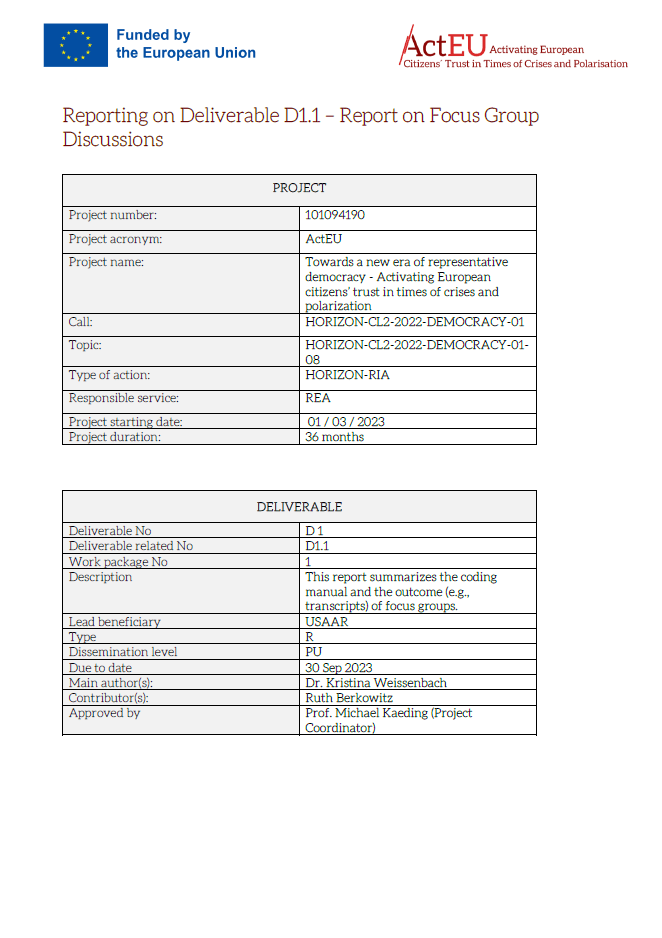
Deliverable 1.1: Report on Focus Group Discussions

Kristina Weissenbach, Ruth Berkowitz

This report shows the design of the focus groups, as part of the exploratory sequential design of the ActEU project. Initial findings on the patterns relating to political participation, emotional and rational aspects, representation and attitudes are presented. It also provides insights into how the focus group data was used to further develop the survey and web scraping. 

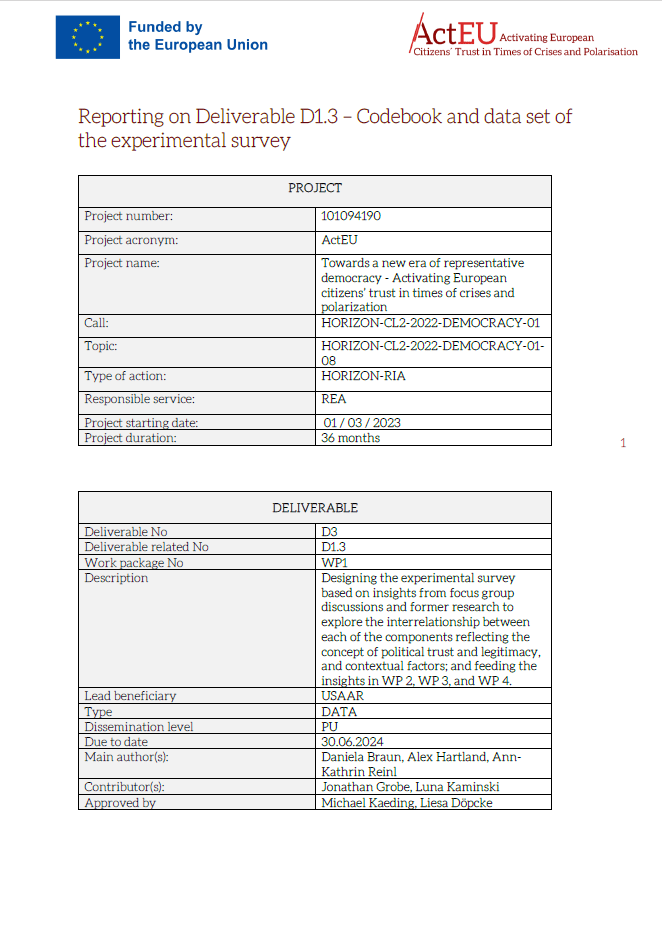
Deliverable 1.3: Codebook and data set of the eperimental survey

Daniela Braun, Alexander Hartland, Ann-Kathrin Reinl

Designing the experimental survey based on insights from focus group discussions and former research to explore the  interrelationship between each of the components reflecting the concept of political trust and legitimacy, and contextual factors.

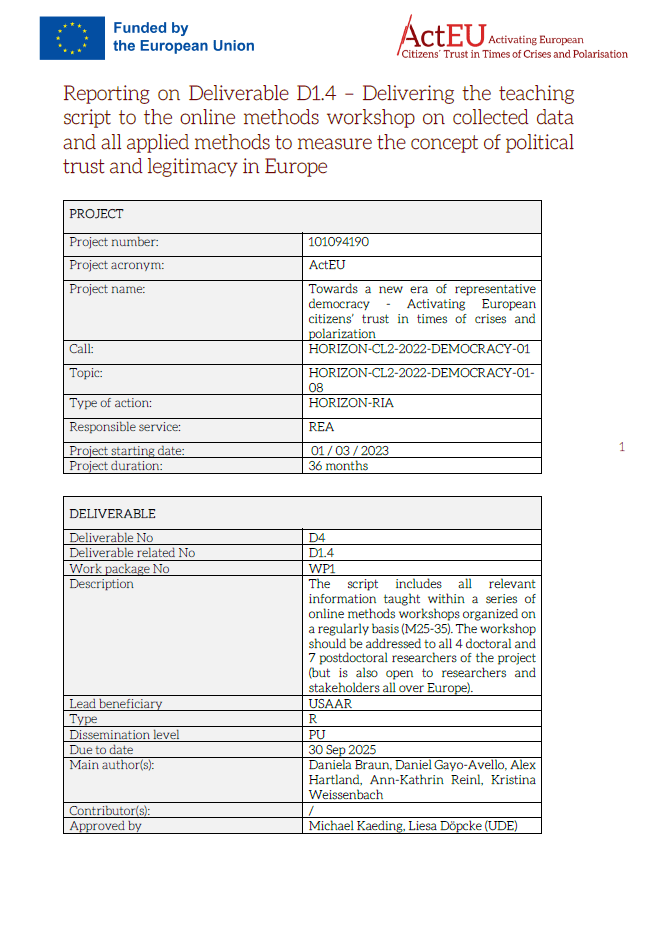
Deliverable 1.4: Delivering the teaching script to the online methods workshop on collected data and all applied methods to measure the concept of political trust and legitimacy in Europe

Daniela Braun, Daniel Gayo-Avello, Alexander Hartland, Ann-Kathrin Reinl, Kristina Weissenbach 

The script includes all relevant information taught within a series of online methods workshops organized on a regularly basis (M25-35). The workshop should be addressed to all 4 doctoral and 7 postdoctoral researchers of the project (but is also open to researchers and stakeholders all over Europe).

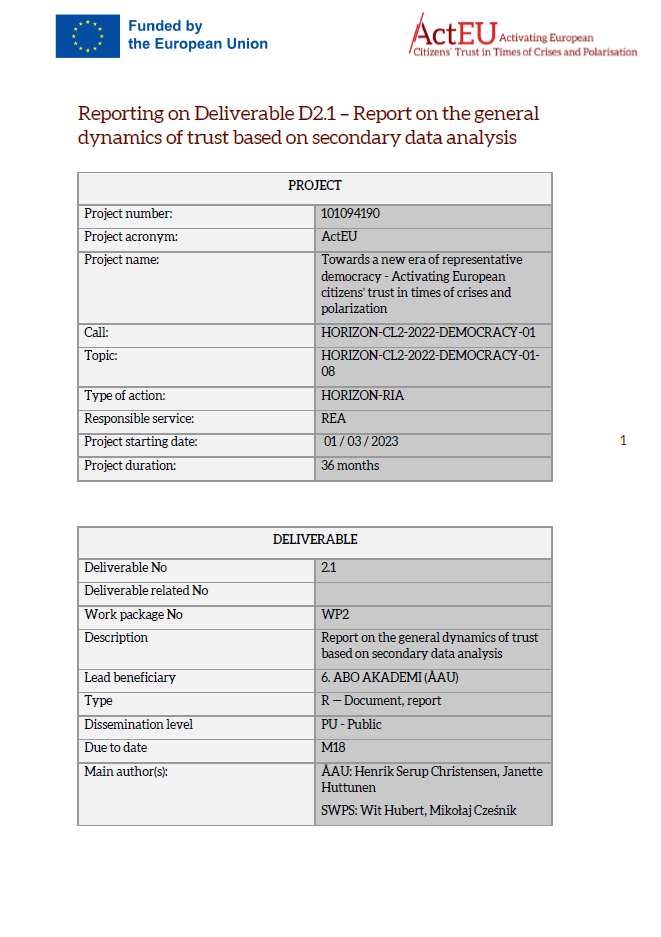
Deliverable 2.1: Report on the general dynamics of trust based on secondary data analysis

Henrik Serup Christensen, Janette Huttunen, Wit Hubert, Mikołaj Cześnik, Alexandros-Christos Gkotinakos, Eftichia Teperoglou, Jens Carstens, Laura Morales, Carles Pamies, Chiao Li

The ActEU project (“Activating European Citizens’ Trust in Times of Crises and Polarisation”) has as one of its main missions to map and investigate persistent problems of declining political trust, legitimacy and representation in Europe. Within the overall project, work package 2 focuses on achieving a better understanding of the nature of these problems by examining citizens’ political attitudes. This report provides a comprehensive and systematic overview of the nature, extent and evolution of the crisis of political trust throughout the European Union (EU) and the United Kingdom (UK) since the
early 2000s.

Deliverable 2.3: Report on how trends in trust among specific social and political groups, including ethnic and territorial identities, territorial attachment and regime types at subnational level impact on varying levels of trust across European subnational units

Henrik Serup Christensen, Janette Huttunen, Carles Pamies, Laura Morales, Max-Valentin Robert, Giulia Sandri, Felix-Christopher von Nostitz

Designing the experimental survey based on insights from focus group discussions and former research to explore the  interrelationship between each of the components reflecting the concept of political trust and legitimacy, and contextual factors.

Deliverable 2.4: Report (including policy recommendations) on variation in political trust across policy areas of climate change, migration and gender

Louisa Parks, Laura Morales, Carles Pamies, Max-Valentin Robert, Matilde Ceron, Zoe Lefkofridi, Roula Nezi

This report gathers chapters that engage with three specific research questions on variations in political trust related to the three policy issues of interest in the ActEU project: climate change, gender, and migration. A key objective of the ActEU project is precisely to investigate the nuances in variations of political trust, and how trust may be shaped differently within specific policy areas that have been characterised by exceptional polarisation in recent years. In line with this view of policy areas or themes as uniquely constructed and perceived, each chapter takes a distinct approach to answer different research questions.

Deliverable D2.5: Report (including policy recommendations) on the consequences of deceitful behaviour for political trust

Henrik Serup Christensen, Janette Huttunen, Laura Morales

In this report, we examine how deceitful behaviours affect evaluations of political leaders. We do so with a conjoint experiment embedded in the ActEU survey. We are therefore able to report causal evidence from 10 European democracies on how politicians’ deceitful behaviours affect how
citizens evaluate them.

Deliverable 3.1: Report on voting behavior in Europe

Carles Pamies, Laura Morales, Luis Ramiro, Alexandros-Christos Gkotinakos, Eftichia Teperoglou, Wit Hubert, Mikołaj Cześnik

This report examines the state of knowledge and the empirical evidence regarding electoral behavior in Europe and its connection to political trust and it has two main objectives in the context of the ActEU project. First it provides a summary of the scholarship on the trends and meaning of electoral abstention and of changes in voting choices in the context of electoral de-alignment, the emergence of new cleavages and increasing polarization, as well as their connection to political trust. Second, it provides a descriptive analysis of those trends and cross-national patterns in electoral turnout and vote choices, as well as its association with political trust. 

The report is structured around five chapters. After an introduction in Chapter 1, the report provides in Chapter 2 an overview of the state of the art on electoral turnout, voting for populist, radical and extremist parties, and the connection to political trust. Chapter 3 describes trends and cross-national patterns of turnout in a multilevel setting across Europe and examines how these are associated with patterns of trust in political actors and institutions. Chapter 4 examines cross-national and longitudinal patterns of voting choices across party families for national legislative elections and the extent to which we can observe a shift in the link between those electoral choices and levels of political trust. Chapter 5 summarizes the key findings and contributions to our state of knowledge and offers policy-relevant recommendations when appropriate.

Deliverable 3.2: Report on changing patterns of citizens' political participation

Carles Pamies, Laura Morales, Chiao Li, Alexandros Christos Gkotinakos, Eftichia Teperoglou, Wit Hubert, Mikołaj Cześnik

This report examines how much patterns of political participation have changed in the last two decades in Europe and whether any such changes can reasonably be linked to the current crisis of representative democracy facing established European democracies. Indeed, it is not uncommon to connect participation in contentious forms of political action with political discontent. This link is, nevertheless, not as straightforward as it may seem at first as non-electoral political participation can be the last resource of the politically alienated but it can also be an additional tool in the political arsenal of those who are the most politically resourceful and confident of making an impact.

Through a systematic comparative analysis of trends and patterns of non-electoral participation in Europe using data from the European Social Survey for the last two decades, this report shows that: (1) Overall trends in political participation vary considerably depending on the mode of political action considered, (2) cross-national variation in the levels, patterns and trends of non-electoral participation is very substantial, (3) The association between trust in national and EU political actors and institutions and participation in non-electoral forms of political action is, on average, nil for most countries and forms of political participation, particularly for Nordic and Central and Eastern European countries. Nevertheless, we observe some meaningful patterns when the correlations are not nil.

In sum, our in-depth analysis of patterns and trends of non-electoral political participation across Europe suggests that there has been no massive change in the last two decades and that we are not witnessing a generalized surge in non-electoral political action that is manifesting a clear syndrome of political discontent. Hence, more nuanced analyses are required to better understand which instances of political mobilization are expressing political disaffection and mistrust of political actors and institutions and by which social and political groups in European democracies.

Deliverable 3.3: Report (including policy recommendations) describing the relationships between trust and participation within the fields of immigration and climate change on the basis of web-scraped data and survey experiments

Louisa Parks, Giulia Sandri, Laura Morales, Carles Pamies, Kristina Weissenbach, Felix-Christopher von Nostitz, Max-Valentin Robert

The central aim of the report is to describe the relationships between political trust and political participation. More specifically, it focuses on the circumstances under which citizens are more likely to choose less conventional and more contentious forms of political participation, especially protest action. While there is extensive literature on declining political trust in general, and its effect on voting behaviour and the rise of radical parties in particular, there are fewer studies on political trust and its links to other forms of political participation, especially more contentious forms of political participation such as protest. Furthermore, past research on trust, mistrust and distrust has revealed no clear consensus about whether a certain degree of political distrust is healthy or unhealthy for representative democracy, as turning to less conventional and more contentious forms of political participation may reflect discontent with the political status quo, but not necessarily signal a lack of political trust. This report addresses this gap by outlining the relationship between trust and participation based on multiple data sources: European Social Survey (ESS) data, the ActEU focus group data, the ActEU survey data including a vignette experiment, and web-scraped data from X. Furthermore, the report outlines if the relationship between political trust and political participation depends on how polarised an issue is by focusing on climate change and immigration policy.

Deliverable 3.4: Report (including policy recommendations) explaining for which groups in society, decreasing trust acts as a critical mediator for the changing pattern of citizens’ political participation in Europe

Felix-Christopher von Nostitz, Max-Valentin Robert, Zoe Lefkofridi, Matilde Ceron, Kristina Weissenbach, Ruth Berkowitz, Louisa Parks

In this report we shift the focus compared to earlier work in work package 3 to focus on the collective side of political participation and the role that trust and distrust play in shaping changing patterns. We take an innovative and exploratory approach, drawing on existing survey data, the ActEU focus groups, and the ActEU web-scraped data from X to investigate these questions from novel angles. The literature on political trust and participation suggests that to properly understand changing patterns, we must pay understand political participation in a broad sense that comprises all collective behaviour engaged in with the intention of shaping political decisions and institutions. It also suggests that longstanding links between some types of political participation and some types of political actors, such as strikes and trades union, or political parties and voting, are changing. Finally, it also suggests that one clear area to explore to shed light on those changes is the field of emotions and how they interact with feelings of political trust and distrust.

Deliverable 4.1: Two datasets on objective descriptive and substantive representation with a particular focus on gender equality, climate change and migration

Laura Morales, Carles Pamies, Nayla Escribano

This report is structured in five main sections. The first section provides an overall introduction to conceptual and theoretical aspects relevant to the study of democratic political representation. Section two takes stock of the existing research and datasets on descriptive and substantive representation, pointing out their limitations. The third section describes the methodology followed for the creation of the dataset on descriptive representation, whereas section four outlines the methodology followed for the creation of the dataset on substantive representation. The final section offers some policy-relevant recommendations that we also briefly summarise here.

Deliverable 4.2: Report (including policy recommendations) on the patterns of objective and subjective representation across countries and across parties within countries

Matilde Ceron, Zoe Lefkofridi, Nayla Escribano, Laura Morales

This report is situated within the broader discourse on the crisis of liberal democracy, a phenomenon marked by declining trust in political institutions and increasing polarisation across Europe. Understanding these ongoing challenges facing European democracies – a key goal of the
ActEU project – requires a nuanced assessment of the quality of political representation. The ActEU project examines the quality of political representation, which is foundational to the functioning of representative democracies, across three dimensions: descriptive representation (the demographic correspondence between citizens and representatives), substantive representation (the alignment of policy preferences and actions with citizens’ interests), and subjective representation (citizens’ perceptions and feelings of being represented).

Deliverable 4.3: Report (including policy recommendations) on the populist far right, representation and their role in view of the new transnational cleavage (migration, climate change, and gender equality)

Petr Kratochvíl, Katarzyna Kochlöffel, Jan Kovář, Laura Morales, Pelin Musil, Luis Ramiro, Zdeněk Sychra

This study explores the so-called populist far right parties and movements in the EU (PFRPs) and their attitudes towards selected policy domains. In the past, the PFRPs were often seen as single-issue parties with a focus on immigration. But given the PFRPs’ electoral successes and the expansion of their political agendas, the question emerges of whether a broader convergence is not taking place around a larger set of issues on which these parties (and their voters) agree. This report sheds light on the relationship of the PFRPs to three such important, politically sensitive issues – immigration, climate change, and gender equality.

Deliverable 4.5: Report studying Central European populism and new cleavages

Katarzyna Kochlöffel, Petr Kratochvíl, Jan Kovář, Pelin Musil, Zdeněk Sychra

This study explores populism in Central Europe (CE). By studying ten populist parties in four countries (Czechia, Hungary, Poland, and Slovakia), it aims to shed light on how similar these parties and their voters’ attitudes are in terms of the policy domains of immigration, climate change, and gender. It also answers the question about whether a new cleavage might be emerging based on the convergence around these issues. The study explores both the supply side (political manifestos) and the demand side (two survey datasets), but it also utilizes web-scraped data to explore the similarities and differences among them.

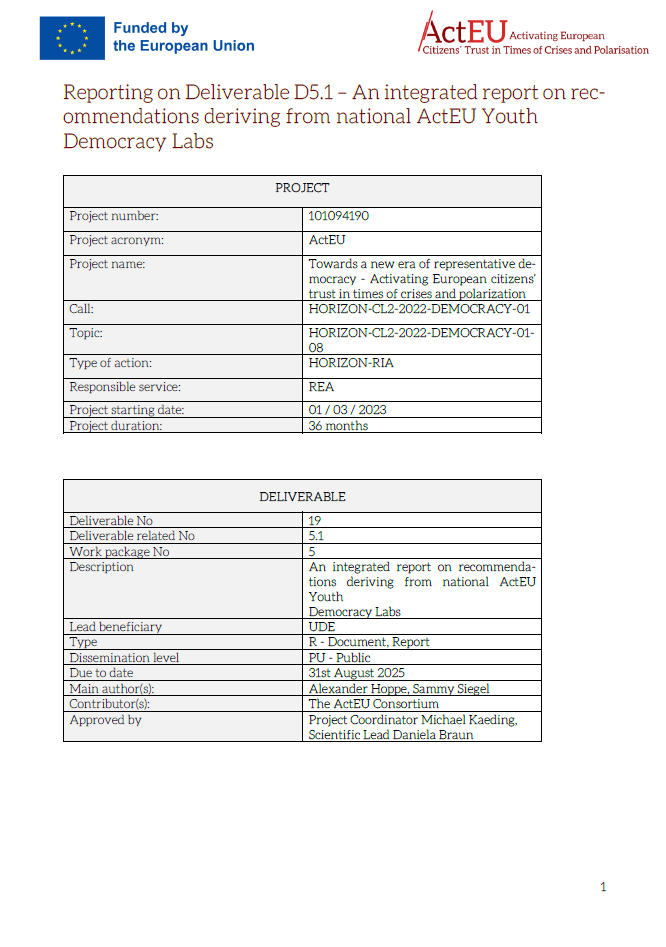
Deliverable 5.1 – An integrated report on recommendations deriving from national ActEU Youth Democracy Labs

Alexander Hoppe, Sammy Siegel

A major aim of the ActEU project is to actively engage with young European citizens and integrate their perspectives into the research process. The ActEU Youth Democracy Labs were designed for exactly this reason. In an interactive process, ActEU partners and participants engaged in a process of co production and developed policy recommendations for policy-makers and the educational sector. The perspective of European youth was taken seriously and their expertise in the issues concerning their everyday-lifes as well as their (political) education used as a valuable input. In 17 Labs, 338 participants produced over 400 recommendations. For this report, the recommendations have been systematically categorized and analysed.

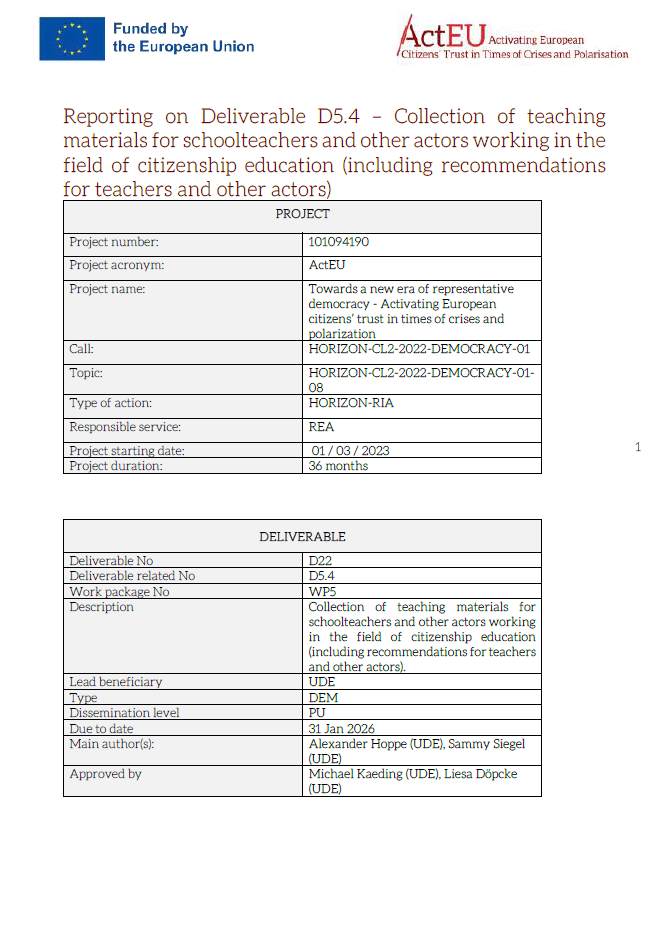
Deliverable D5.4 – Collection of teaching materials for schoolteachers and other actors working in the field of citizenship education (including recommendations for teachers and other actors)

Katarzyna Kochlöffel, Petr Kratochvíl, Jan Kovář, Pelin Musil, Zdeněk Sychra

ActEU had the ambition to translate its findings into practical tools to strengthen democratic engagement and political participation within the European Union’s multi-level governance system. A central outcome of this effort is the ActEU Toolkit for the Educational Sector, designed to support educators in schools, universities, and civil society organizations.

The toolkit is firmly grounded in ActEU’s research and was developed through consultations with civil society actors, ensuring that it responds to concrete educational needs and real-world teaching contexts.

The toolkit is structured into five complementary components: A comprehensive collection of online educational resources on the EU political system; ready-to-use templates for interactive workshops tailored to different age groups; video material presenting ActEU research findings in accessible formats; visually engaging infographics for concise knowledge transfer; and educational cartoons designed to stimulate discussion and reflection.

Deliverable 6.1 – Communication, Dissemination and Exploitation Plan

Hugh Evans

This document, deliverable D6.1 within the ActEU project, functions as the prime reference point for the project’s communications, dissemination and exploitation activities, variously implemented in the framework of Work Package 6 as well as throughout other thematic Work Packages. Hereafter are outlined all major elements of the project’s activities in this area: overall and specific objectives, main target groups, channels used to reach those groups as well as methods employed on those channels, measures taken to secure communication within the project’s consortium and a risk assessment and mitigation plan. In addition, this document outlines guidelines for use of the project’s visual identity and rules for ensuring the visibility and transparency of ActEU’s European funding. Key Performance Indicators are established, as well as ways the project will track its achievement in them. This document is the first, and most important, step in implementing ActEU’s communications, dissemination and exploitation.

Deliverable 7.1: ActEU Management Handbook including quality assurance, risk assessment and contingency plan (V3)

Michael Kaeding

The Management Handbook structures the collaboration of the consortium, the scientific lead and the coordinator in the project ActEU. First, it gives an overview of the general information of the project and the important dates during the project. It informs about the rules and procedures for meetings, such as the general assembly and the three main conferences. Since reporting is of high importance in the project, the legal points as well as the ActEU specific procedures are described here. Regarding the budget, the budget flexibility as well as amendments, the relevant points from the grant agreement are summarized and complemented by the concrete procedures of ActEU. Since the first data is already being collected in the project, the handbook contains information on data management, which will be expanded by the data management plan. As the dissemination of the project’s results is highly relevant, the manual contains information on publications and the acknowledgement of EU funding/disclaimer. To ensure the success of the project, a quality assurance, risk assessment and contingency plan was prepared. Moreover, information is provided on the digital infrastructure set up by the coordinator. In addition to the information, the manual contains practical advice on project procedures and communication to ensure efficient cooperation.

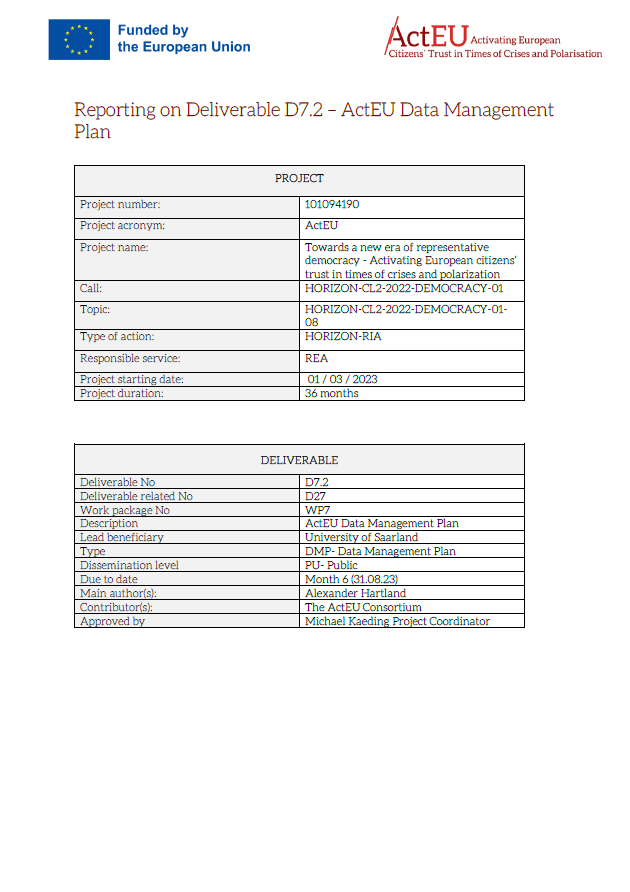
Deliverable 7.2: ActEU Data Management Plan

Alexander Hartland

This is deliverable D7.2, Data Management Plan (First Version), for the ActEU project. The purpose of the DMP is to provide an overview of all the data, tools, and new knowledge collected, used, and generated by the project. Furthermore, the DMP describes the main dimensions of data management and curation. Specifically, the DMP is designed to ensure adherence to FAIR principles (by, for example, promoting interoperability through the use of metadata standards or facilitating data sharing, amongst other aspects). All the datasets included in the DMP will be deposited in an open repository (Zenodo and/or GESIS) and linked to the DMP

Discover the latest insights and research from our ActEU community – explore our Zenodo page here: https://zenodo.org/communities/acteu/records?q=&l=list&p=1&s=10&sort=newest