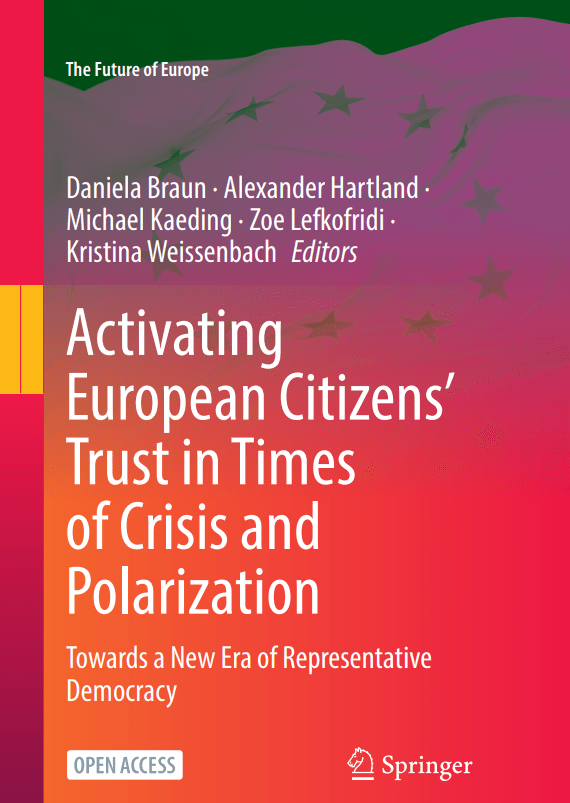
Activating European Citizens’ Trust in Times of Crisis and Polarization: Towards a New Era of Representative Democracy

Editors: Daniela Braun, Alexander Hartland, Michael Kaeding, Zoe Lefkofridi, Kristina Weissenbach

This open access book explains why representative democracies need political trust and legitimacy: Political trust is a crucial yet underestimated element in Europe’s representative democracies. A trusting relationship between citizens and the institutions of the state ensures the functioning of democratic systems, reduces transaction costs and facilitates the justification of political decisions. Without the commitment of a critical mass, democratic governments cannot gain legitimacy among the populace. While a stable relationship of trust between citizens and the state through political parties is a prerequisite for representative democracies in normal times, it is even more important in times of significant democratic change and turmoil, i.e., when democracies are in flux. Accordingly, the contributions gathered here examine political trust and legitimacy in Europe using a new conceptual framework – the ActEU conceptual triangle, which draws on citizens’ political attitudes, their political participation, and the representation of their political preferences to map and assess the decline of political trust and legitimacy in Europe.

https://link.springer.com/book/9783032191182

The role of key European issues in the 2024 election campaign

Alex Hartland, Daniela Braun, Giuseppe Carteny,
Rosa M. Navarrete and Ann-Kathrin Reinl

International crises and Euroscepticism have made European issues prominent in citizens’ lives. This article studies the role of three key European issues – migration, the environment, and EU integration – for political parties and citizens. The analysis centres on nine EU member states, combining party manifestos from the 2024 European Parliament elections with survey data. It finds a gap between the concerns of citizens and the political parties, an important consideration for election campaigns in general. Moreover, the analysis suggests that the salience in party manifestos has a modest direct influence and a stronger indirect impact on their appeal to citizens in most countries studied. Specifically, citizens concerned with migration and the environment evaluate parties based on the prominence they give to these issues during the campaign. The findings offer important avenues for further research on party issue emphasis and the measurement of issue salience via large language models (LLMs).

https://doi.org/10.1080/01402382.2025.2498838

Politisches Vertrauen in Europa im Kontext von Mehrebenenstruktur und Polarisierung: Konzeptionelle Überlegungen

Daniela Braun and Michael Kaeding

European democracy is undergoing profound change. The various crises of the past 15 years and the transformations associated with modernisation, globalisation, geopolitics and Europeanisation are threatening the trust of citizens in political actors and institutions and the legitimacy of the EU multi-level system. This goes hand in hand with the polarisation of European societies. In order to counter these developments, the problems of trust and legitimacy must be better researched. This is where the ActEU research project “Towards a new era of representative democracy. Activating European Citizens’ Trust in Times of Crises and Polarisation” comes in. This article provides an overview of the underlying conceptual considerations of the Horizon Europe project.

https://doi.org/10.5771/0720-5120-2024-2-154