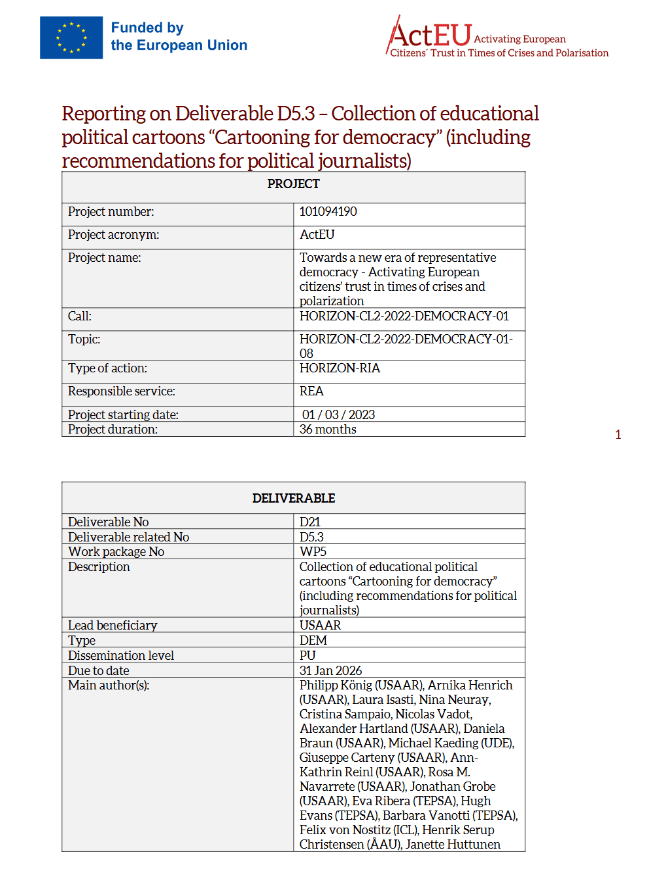
Philipp König, Arnika Henrich, Laura Isasti, Nina Neuray, Cristina Sampaio, Nicolas Vadot, Alexander Hartland, Daniela Braun, Michael Kaeding, Giuseppe Carteny, Ann-Kathrin Reinl, Rosa M. Navarrete, Jonathan Grobe, Eva Ribera, Hugh Evans, Barbara Vanotti, Felix von Nostitz, Henrik Serup, Alexander Hoppe, Ermela Gianna, Matilde Ceron, Zoe Lefkofridi, Louisa Parks, Katarzyna Kochlöffel, Petr Kratochvíl, Jan Kovář, Pelin Ayan Musil, Zdeněk Sychra, Carles Pamies, Laura Morales, Chiao Li, Alexandros-Christos Gkotinakos, Eftichia Teperoglou, Wit Hubert, Mikołaj Cześnik
The cartoons produced within the ActEU project grow out of its core ambition: to explore the drivers of political trust in Europe and communicate these insights in an engaging and accessible way. Rather than addressing policymakers directly through traditional formats, the project translates key findings into visual narratives developed by external cartoonists.
The selected themes reflect central findings of the ActEU project. One set of cartoons highlights how immigration remains the key issue unifying far-right actors across Europe, cutting across national contexts and political systems. Another focuses on the differentiated evolution of political trust,
showing that trust in politics is not uniformly declining but rather drifting in different directions depending on citizens’ geographical, social, and political position within Europe. A further theme addresses populist discourse in Central Europe, illustrating how it is largely driven by political elites rather than emerging from bottom-up public demand.
Participation and representation form an additional cross-cutting theme. In particular, the cartoons draw attention to the systematic underrepresentation of young people in formal political institutions, despite the growing visibility of youth-related concerns in political debate. By visualising this gap between attention and actual inclusion, the cartoons highlight how limited opportunities for meaningful participation can undermine trust and weaken democratic
engagement.
We also identify a number of recommendations for political journalists, from the importance of local/ bottom-up political perspectives to an emphasis on transparency and monitoring of current affairs. Each recommendation is directly linked to the cartoons and designed to be presented in tandem.
Together, the cartoons transform key ActEU findings into compelling visual metaphors that encourage reflection, debate, and critical engagement with the conditions under which political trust is built—or lost—across Europe